


Pyth Network is drawing renewed attention after a recent thread from market commentator Whale Factor outlined the project’s push into institutional financial data.
Summary
- Pyth is expanding beyond DeFi with institutional data products and enterprise revenue growth.
- PYTH has recovered from recent lows, though major token unlocks remain a concern.
- Traders are watching whether adoption growth can outpace future supply entering markets.
The discussion comes as PYTH trades near $0.039 after rebounding from its June low, while investors assess whether growing adoption can offset supply concerns.
The project has traditionally operated as a blockchain oracle network, providing price data to decentralized applications. More recently, Pyth has expanded into institutional market data services, a move that places it in competition with established financial information providers.
Pyth expands beyond crypto data services
Pyth’s core business centers on supplying real-time market data to blockchain applications. Unlike many oracle networks that aggregate information from external APIs, Pyth receives data directly from exchanges, trading firms, and market makers.
According to Whale Factor, firms including Jane Street, Cboe, Jump Trading, and Virtu are among the contributors publishing pricing information through the network. The model aims to reduce latency and improve data quality for decentralized finance applications.
The project has also expanded the range of information available through its network. In addition to cryptocurrency prices, Pyth now distributes data covering equities, foreign exchange markets, commodities, and macroeconomic indicators.
Institutional products become a growth focus
The network’s recent strategy shift has focused on institutional clients rather than solely decentralized finance users. The launch of the Pyth Data Marketplace introduced a platform where institutions can distribute proprietary market information while retaining control over monetization.
According to the post, organizations including Fidelity, Euronext, and Tradeweb have joined the initiative. The platform is designed to support data products such as foreign exchange pricing, precious metals data, and ETF valuation information.
Another product, Pyth Pro, provides subscription-based access to premium market feeds. Whale Factor stated that the service surpassed $1 million in annual recurring revenue shortly after launch. Enterprise clientsreportedly include Kalshi, a regulated U.S. prediction market platform.
As previously reported by crypto.news, institutional demand for blockchain-based financial infrastructure has continued to grow as tokenization and real-world asset projects expand. Oracle networks are expected to play a key role in supplying reliable external data to these systems.
PYTH price stabilizes after prolonged decline
Despite operational growth, PYTH remains far below its historical peak. The token trades around $0.0388, according to crypto.news market data. The asset is still down more than 96% from its March 2024 all-time high near $1.20.
Technical indicators suggest selling pressure has eased. The daily chart continues to show a long-term bearish structure, though price action has shifted into consolidation near recent lows.
Bollinger Bands have narrowed, indicating reduced volatility. Price currently trades slightly above the middle band, reflecting a neutral short-term trend. The Bull Bear Power indicator has turned modestly positive, suggesting buyers hold a slight advantage, although momentum remains weak.
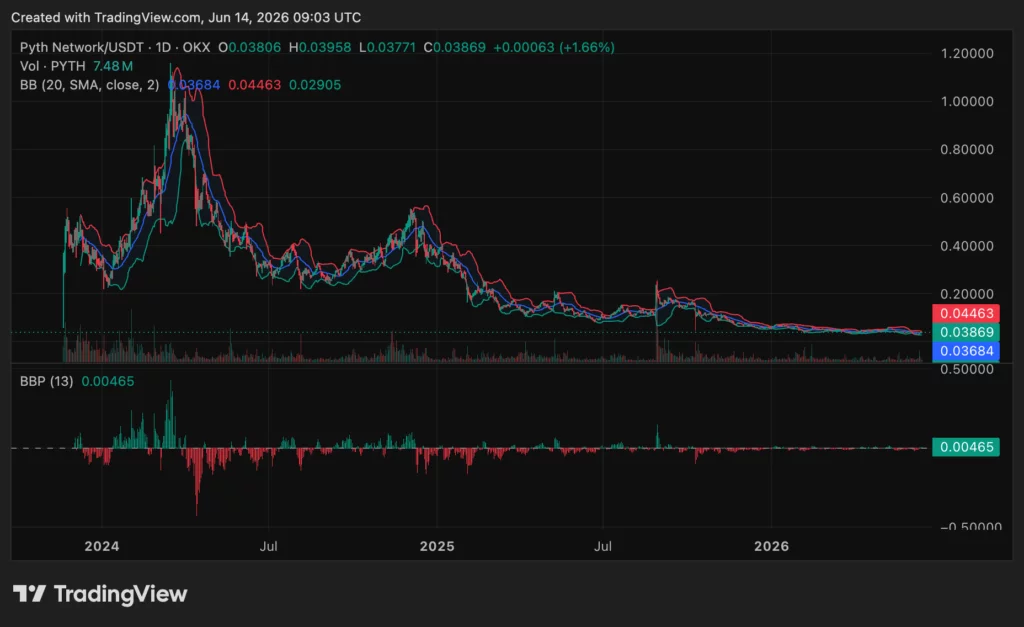
Trading volume has also declined compared with earlier periods. That pattern indicates investors remain cautious while waiting for stronger confirmation of a directional move.
Token unlocks remain a major consideration
While institutional adoption has become a central part of the Pyth investment narrative, future token supply remains an important factor for market participants.
The network has a maximum supply of 10 billion PYTH tokens, with approximately 7.87 billion currently in circulation. According to Whale Factor, roughly 21% of total supply remains locked and is scheduled for future release.
Market participants continue to monitor how upcoming unlocks could affect price performance. Previous unlock events coincided with periods of weakness, increasing concerns that additional supply may create selling pressure if demand growth fails to keep pace.
For now, investors are weighing two competing trends. On one side are expanding enterprise products, recurring revenue, and institutional partnerships. On the other are token supply increases and a market that remains well below previous cycle highs.
The next phase for PYTH may depend on whether growing adoption of its data products translates into sustained demand for the token itself. Until then, the asset remains in a consolidation phase as traders watch for a breakout above resistance or a retest of recent lows.
Disclosure: This article does not represent investment advice. The content and materials featured on this page are for educational purposes only.
