
Disclosure: This article does not represent investment advice. The content and materials featured on this page are for educational purposes only.
MiCA’s full implementation has reshaped Europe’s crypto market, with hundreds of firms securing CASP licenses while many others exited or restructured.
Summary
- MiCA leaves just 244 licensed crypto firms operating in the EU as thousands exit the market or suspend services after the July deadline.
- Europe’s MiCA rules reshape the crypto industry, with only 244 firms securing CASP licenses as stricter compliance takes effect.
- The EU’s MiCA framework causes a major crypto market shake-up, leaving hundreds licensed while thousands face closures or restructuring.
Overnight, MiCA wiped out 80% of the 3000+ companies with VASP licensing from the European crypto market. Only a handful of companies survived, around 244 as of today. So, what did the rest of 2700+ companies have to do to stay afloat?
MiCA Impact — damage and gains for the market
MiCA has officially entered the market. On the 1st of July, 2026, the transitional period for MiCA in the EU expired. More than 3,000 companies holding VASP licenses were faced with a critical choice: either cease operations or find a viable path forward. Only 244 projects managed to push past MiCA regulatory scrutiny, while the rest 80% of Europe’s crypto market had to make do.
VASP license meant a company was able to operate as a Virtual Assets Service Provider, which is as legal as it gets in crypto.
Even legitimate companies were impacted.Out of 1200+ projects with pre-MiCA registrations, only 17% secured a full CASP legal framework needed to operate under the new ruleset. Binance filed a MiCA application in Greece in January 2026, but failed to comply due to undisclosed reasons. CZ claimed it was a political decision not to license Binance.
Some of the big names have managed to obtain a MiCA license. Coinbase and Kraken registered with the Central Bank of Ireland, OKX and Crypto.com with Malta’s MFSA, Bitstamp picked Luxembourg and Revolut is now in CySEC, Cyprus.
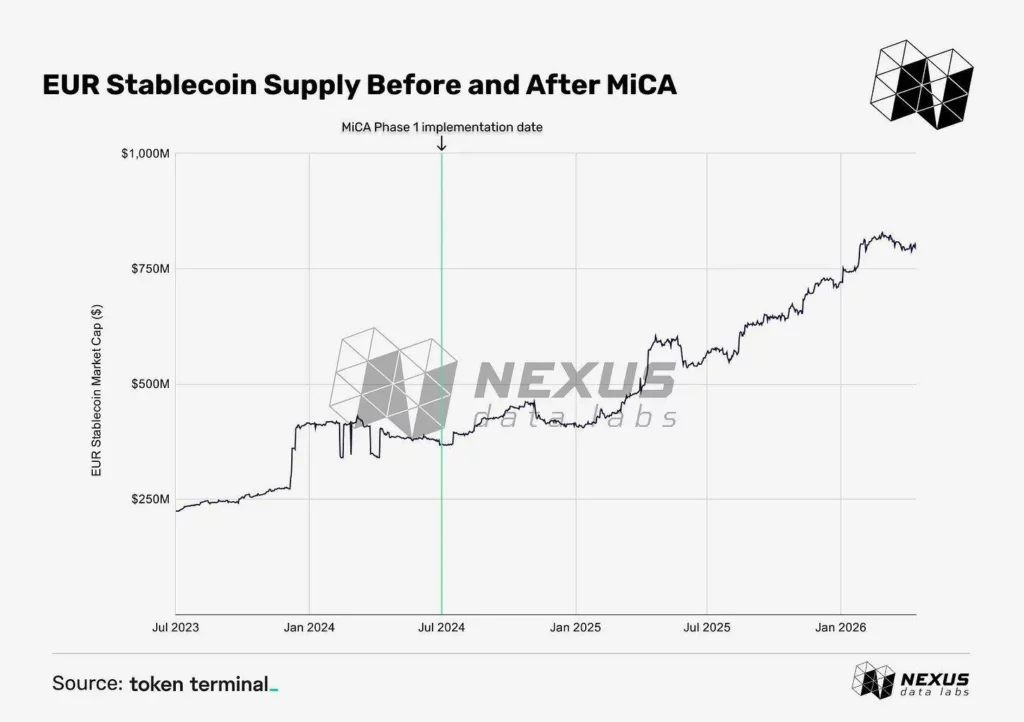
However, the introduction of MiCA was not entirely negative as at least EUR stablecoin use skyrocketed after a phase 1 implementation.
What changed for crypto companies in the EU?
First and foremost, individuals can no longer launch a startup without being subject to regulatory scrutiny. Legally, Crypto in the EU is now treated as traditional finance, which has its own regulatory framework called MiFID II.
The days of garage-based operations are officially over. Europe becomes a tightly regulated space where every move has to be documented, every risk recorded, and AML/KYC checks strictly enforced. For one, it’s harder to innovate in an overly regulated space; on the contrary, it’s much safer to deal with.
It also means that companies can’t operate even if they are getting the license. If a crypto project tries to work with its own users while getting the license, operating under “Pending Application” can now cost a crypto company €15M or $17.1M in fines. As an alternative, they can hand over 12.5% of their annual turnover.
Cooperation rules have changed too. Crypto companies have to report their users to regulatory and financial authorities, not on demand, but on their own. In exchange, survivors of the MiCA slaughter who managed to obtain a CASP license can now access all member states with only one registration.
Targeting rules have also changed heavily. Even 1 EU influencer in the marketing campaign means they must be MiCA compliant now. If the app or project targets the EU specifically, then it has to be regulated.
On July 1st, money had to change hands from 2800 platforms to the surviving 244, which meant an influx of frozen funds. Binance had to freeze spot orders, sign-ups, deposits and staking products for users in France, Italy, Spain, and Poland. DeFi protocols had to pull the plug; Base’s Seamless Protocol and apps like PPL Wallet just physically shut their servers down. The 2800 platforms each had some way of storing or operating user funds, and if users didn’t withdraw their money is now being held because neither company has a legal allowance to actually send user money back.
But being MiCA-compliant costs a small fortune. According to Pharaon Production research, it can cost up to $1M in upfront costs even before you serve the first customer.
How can crypto projects make do after MiCA?
Many are choosing not to play regulatory tug-of-war and simply walk out for Dubai (VARA) or Singapore (MAS). Others are choosing workarounds that provide the same level of regulatory legality while not asking for $1M in upfront costs and dragging the whole company through bureaucratic torturing devices.
Switzerland’s FINMA supervision can be obtained via SRO (Self-Regulatory Organization). Under Swiss law, being a member of SRO is mandatory if a company wants to handle digital assets, which makes it a reason Zurich is so heavily nested with web3 projects, with more than 1749 crypto companies registered in Switzerland’s Crypto Valley alone. Swiss law doesn’t stand still either: in October of 2025 they opened up two new types of FINMA-supervised license categories.
The Swiss solution to MiCA slaughter is simple: come to the country, register with SRO or acquire the SRO-compliant company, and be free to go while being legally sound. One recent example is Neyro, an agentic project that was in the process of obtaining MiCA license but had to pivot to a Swiss SRO in order to sustain operations.
However, acquisition doesn’t mean free pass right from the gate. Companies involved still have to go through the regulatory checkups, but overall, it is the same level of legality without added scrutiny.
Disclosure: This content is provided by a third party. Neither crypto.news nor the author of this article endorses any product mentioned on this page. Users should conduct their own research before taking any action related to the company.
